Learn · 4 min read
How to Find the Vertex of a Parabola on a Graphing Calculator
The direct answer: the vertex is the turning point
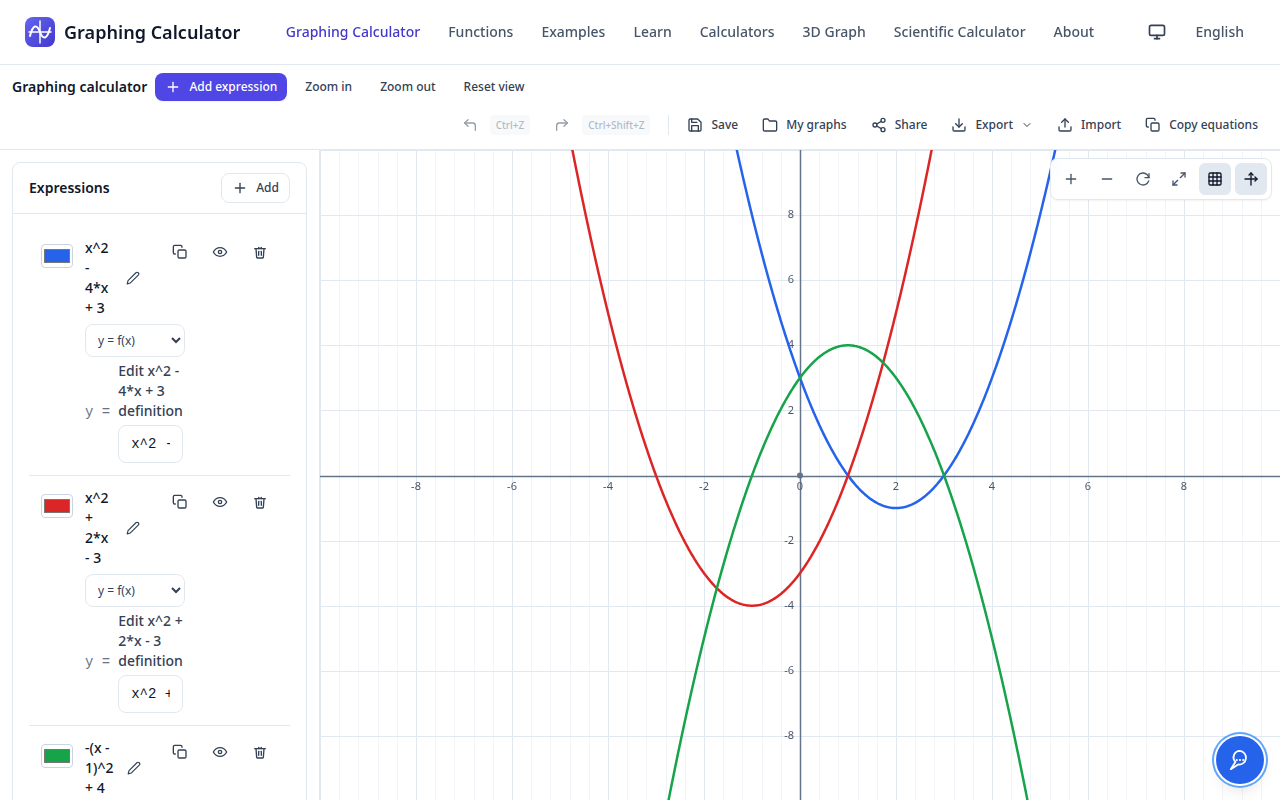
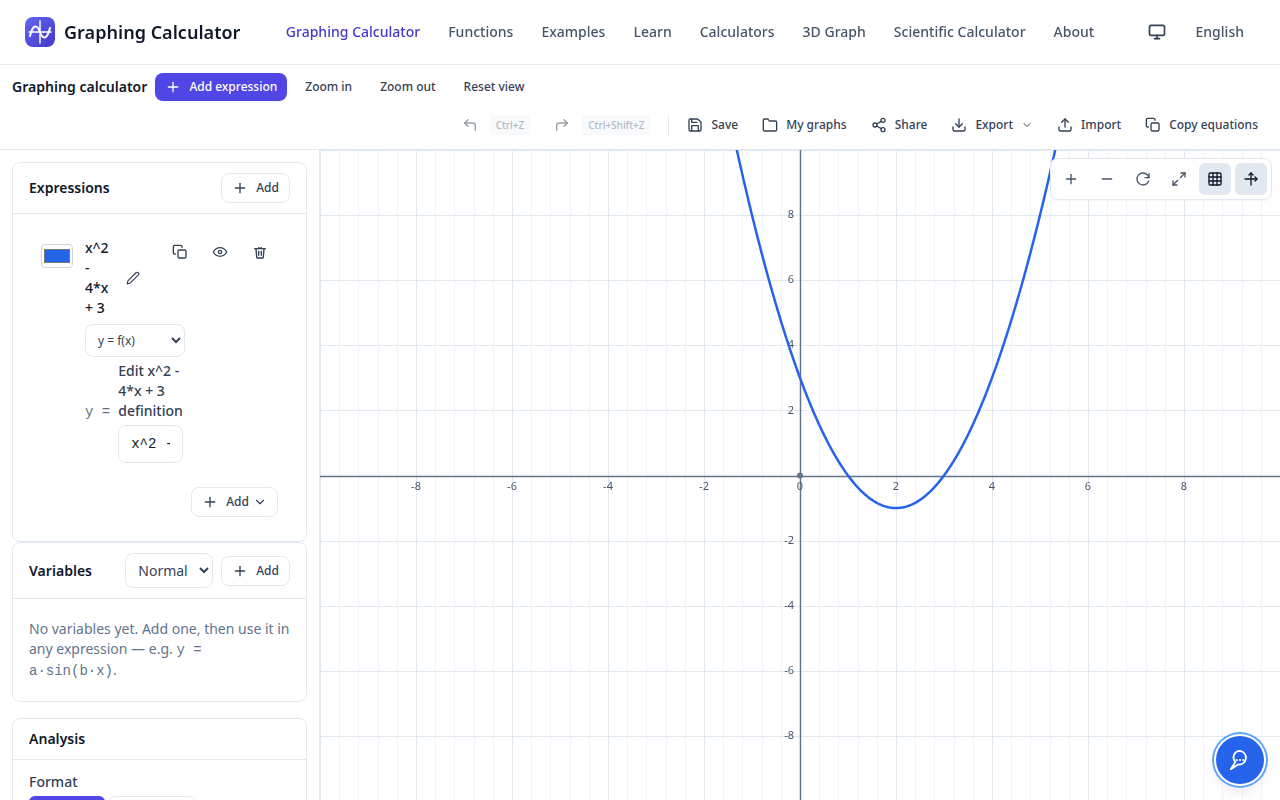
Type the parabola — say x^2 - 4*x + 3 — into a y = box, and look for the single point where the curve turns around. That turning point is the vertex: the lowest point if the parabola opens upward, the highest if it opens downward. For x^2 − 4x + 3 it sits at (2, −1), and you can read it straight off the graph.
Reading it off the graph is fast but approximate — the picture gives you the location, not exact coordinates. This article gives you two exact methods, vertex form and the −b/2a formula, plus a slider trick that makes the vertex visibly move, so you never have to guess.
Vertex form hands you the vertex directly
A parabola written as y = a(x − h)² + k has its vertex at (h, k) — no computation needed. In y = -(x - 1)^2 + 4, the vertex is (1, 4): the squared term is never positive, so the whole expression is largest exactly when the square is zero, at x = 1. The sign of a tells you which kind of vertex it is: a > 0 opens upward (the vertex is a minimum), a < 0 opens downward (a maximum).
You can convert any standard-form quadratic by completing the square. For x^2 − 4x + 3: take half of −4, square it to get 4, and rewrite as (x² − 4x + 4) − 1 = (x − 2)² − 1. There is the vertex again at (2, −1). The two forms describe the same curve — vertex form just puts the answer in the open.
From standard form: x = −b/2a
For y = ax² + bx + c, the vertex's x-coordinate is always x = −b/2a, and the axis of symmetry is the vertical line through it. Take x^2 + 2*x - 3: here a = 1 and b = 2, so x = −2/2 = −1. Substitute back — f(−1) = 1 − 2 − 3 = −4 — and the vertex is (−1, −4). Two steps, no graphing required.
Confirm it in the calculator with evaluate-at-a-point: evaluate your expression at x = −b/2a and check the y-value matches your hand computation. It is a ten-second sanity check that catches sign errors in the formula, which are the classic mistake here.
The axis of symmetry is worth picturing too: the parabola is a mirror image across the vertical line x = −b/2a, so f(−b/2a + d) = f(−b/2a − d) for any d. You can draw that axis as a parametric expression (for example x = −1, y = t) and watch it split the curve into mirror halves.
Watch it move: slider variables
Type a*(x - h)^2 + k into a y = box. The letters a, h and k are free identifiers, so the calculator turns each into a slider you can drag. Pull h left and right and the vertex slides horizontally; pull k and it slides vertically; drag a through zero and watch the parabola flip from a minimum to a maximum — the vertex jumping from the bottom of the curve to the top as a changes sign.
This is the fastest way to build intuition for transformations: the vertex of a(x − h)² + k is always (h, k), and the sliders prove it live. As a check, set a = 1, h = 2, k = −1 and confirm the curve becomes x^2 − 4x + 3 — expanding (x − 2)² − 1 gives exactly that.
Confirm with the extremum marker
A parabola's vertex is also its one local extremum — and its global one, since the arms run to infinity. So the analysis panel's local min/max markers find the vertex directly: drop a minimum marker on x^2 - 4*x + 3 and it lands on (2, −1). For upward-opening parabolas use the minimum marker; for downward-opening ones, the maximum marker.
Treat the marker as a numerical confirmation and the formulas as the exact answer: the marker computes from the sampled graph, while −b/2a and vertex form are exact algebra. Note the division of labor with the general min/max workflow — that covers extrema of messier curves, but for parabolas the vertex methods above are shorter and exact.
Try it in the calculator
Type any of these into the graphing calculator to see the ideas above in action:
- x^2 - 4*x + 3
- x^2 + 2*x - 3
- -(x - 1)^2 + 4
Key takeaways
- The vertex is the parabola's turning point: a minimum if a > 0, a maximum if a < 0.
- In vertex form a(x − h)² + k, the vertex is (h, k) — read it directly.
- In standard form ax² + bx + c, the vertex sits at x = −b/2a on the axis of symmetry.
- Type a*(x - h)^2 + k to get draggable sliders that move the vertex live.
- The analysis panel's min/max marker lands exactly on the vertex — a parabola's extremum is global.
Frequently asked questions
Is the vertex the same thing as the local minimum or maximum?
For a parabola, yes. Its single turning point is the vertex, and because the arms run to infinity it is also the global minimum (a > 0) or global maximum (a < 0). That is why the extremum marker finds it.
My quadratic is in factored form, like (x - 1)*(x - 5). Where is the vertex?
Use symmetry: the roots are 1 and 5, so the vertex's x-coordinate is their midpoint, 3. Then f(3) = (2)*(−2) = −4, giving the vertex (3, −4).
Does −b/2a work for every quadratic?
Yes — for any y = ax² + bx + c with a ≠ 0. But if the equation is already in vertex form a(x − h)² + k, skip the formula and read (h, k) straight off.
Related pages
- Quadratic Function
- How to Solve Quadratic Equations on a Graphing Calculator
- How to Find Local Minimum and Maximum Values on a Graphing Calculator
- How to Transform Functions: Shifts, Stretches and Reflections on a Graphing Calculator
- How to Evaluate a Function at a Point on a Graphing Calculator
- Graphing Calculator Window and Zoom Settings: A Practical Guide
- Projectile Motion: Graphing a Thrown Ball