Learn · 4 min read
How to Graph Inverse Trig Functions (arcsin, arccos, arctan)
The direct answer: type asin, acos, atan
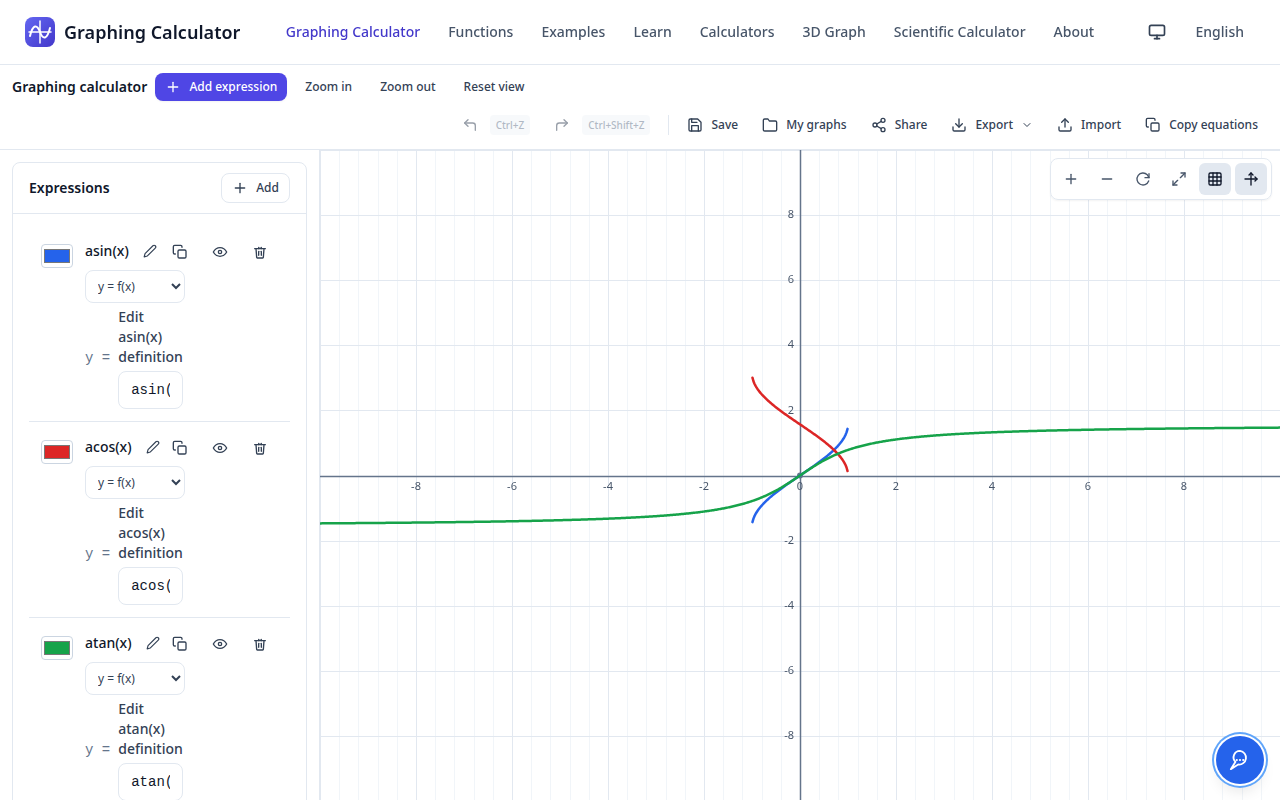
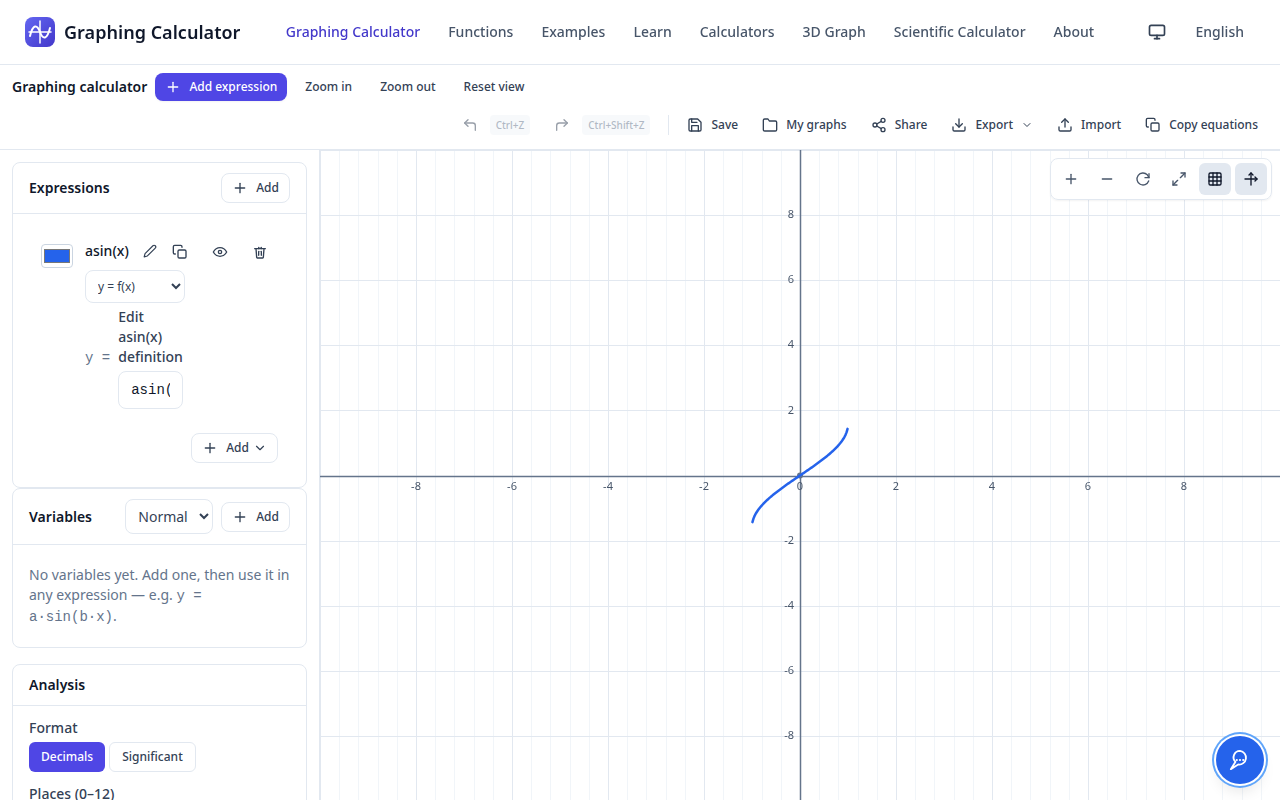
Type asin(x) for arcsine, acos(x) for arccosine, and atan(x) for arctangent. The longer names arcsin, arccos and arctan work too — they are aliases for the same functions. What you get are three short, modest curves near the origin, and that is correct: each inverse trig function returns exactly one angle per input, so its graph is a single branch.
One thing to settle immediately: the calculator works in radians. The outputs are angles measured in radians, so asin(1) = π/2 ≈ 1.5708, not 90. If your class works in degrees, the conversion is one multiplication — covered below.
What you'll see: three short curves
y = asin(x) is an S-shaped curve through the origin, running from (−1, −π/2) up to (1, π/2) — steep at the ends, gentle in the middle. y = acos(x) is its downward-tilted counterpart: it falls from (−1, π) to (1, 0), crossing the y-axis at (0, π/2). y = atan(x) is the stretchiest of the three — an S through the origin defined for every x, flattening toward the horizontal asymptotes y = π/2 above and y = −π/2 below without ever touching them.
Anchor them with exact points: asin(−1) = −π/2, asin(0) = 0, asin(1) = π/2; acos(0) = π/2; atan(1) = π/4. Each curve is the reflection of its parent trig function — restricted to one monotonic piece — across the line y = x. That is why asin undoes sin: evaluate sin(asin(0.5)) at a point and watch the round trip come out to exactly 0.5.
Choose the window to suit the family: x from −2 to 2 frames all of asin and acos comfortably, while atan deserves a wider view (say −10 to 10) so its long flattening tails read clearly. And transformations behave honestly here — graph y = asin(2*x) and the domain shrinks to [−1/2, 1/2], because |2x| ≤ 1 is what the function requires. The algebra always tells you where the curve is allowed to live.
Why the graphs stop: domains and principal values
asin and acos accept only inputs between −1 and 1, because no angle has a sine or cosine outside that range. Type asin(2) and you get nothing — not a calculator malfunction, just an empty graph, because the function genuinely has no value there. atan has no such restriction: every real input produces an angle, which is why its curve runs the full width of the screen.
The “principal value” idea is why you see one curve instead of infinitely many. Infinitely many angles share the same sine, but a function must return exactly one output per input — so asin returns the angle in [−π/2, π/2], acos the one in [0, π], and atan the one in (−π/2, π/2). This is also why each parent is first restricted to an interval where it passes the horizontal line test: sin on [−π/2, π/2] is one-to-one, so it has a true inverse there.
Radians in, radians out — converting to degrees
Because the calculator's trig functions take radians, keep your inputs in radians when you compose: asin(sin(1)) is meaningful with 1 as a radian measure. The input to asin itself is a ratio — opposite over hypotenuse, say — so it carries no units at all; the units question only bites on the way out.
To read an answer in degrees, multiply the output by 180/pi. Type asin(0.5)*180/pi and the calculator returns 30 — the familiar angle whose sine is 1/2. And if a problem asks for “the angle whose sine is 0.5” and expects 30°, the calculator's 0.5236 is the same answer wearing radian units.
Check yourself: the round trip
The quickest way to trust these graphs is the round trip: pick x = 0.5, evaluate asin(0.5) ≈ 0.5236, then evaluate sin of that result — you get 0.5 back. Do the same with acos and atan. If the composition returns your starting number, both the function and the graph are doing their job.
One subtlety worth knowing: the round trip only cooperates in one order on the principal range. asin(sin(x)) = x holds for x in [−π/2, π/2], but outside that interval you get the equivalent angle inside the range instead — the function always lands on its principal branch. For a striking demo, graph y = asin(sin(x)): the principal-value rule folds the sine wave into a perfect triangle wave. That is not a calculator quirk; it is the definition doing its job.
Try it in the calculator
Type any of these into the graphing calculator to see the ideas above in action:
- asin(x)
- acos(x)
- atan(x)
Key takeaways
- Type asin(x), acos(x), atan(x) — arcsin, arccos and arctan are aliases for the same functions.
- Each graph is a single principal branch: asin → [−π/2, π/2], acos → [0, π], atan → (−π/2, π/2).
- asin and acos are defined only for |x| ≤ 1; atan is defined everywhere, with horizontal asymptotes y = ±π/2.
- Outputs are in radians — multiply by 180/pi for degrees.
- Verify with the round trip: sin(asin(0.5)) = 0.5.
Frequently asked questions
Why does my arcsin graph stop at x = 1?
Because arcsine is only defined for inputs from −1 to 1 — no angle has a sine outside that range. The graph ends where the function ends; nothing is missing.
How do I get degree answers instead of radians?
Multiply the output by 180/pi. For example, asin(0.5)*180/pi gives 30, the degree measure of the angle whose sine is 1/2.
Can I see the other branches of arcsine, not just the principal one?
Each branch is itself a function, so you can plot them separately: asin(x) + 2*pi draws the branch shifted up one full turn. They all satisfy sin(y) = x — the calculator simply defaults to the principal branch, as every standard asin does.
Related pages
- How to Graph Inverse Functions on a Graphing Calculator
- Sine Function
- Cosine Function
- Tangent Function
- Asymptotes: Vertical, Horizontal, and Oblique
- How to Transform Functions: Shifts, Stretches and Reflections on a Graphing Calculator
- Amplitude, Period and Phase Shift: Graphing Sine and Cosine Transformations